

The perfect batting stance: Does it exist?
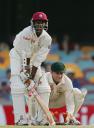 Shiv Chanderpaul averages in the high 40's in Test cricket yet if I saw a kid I was coaching with a front on stance like that I would be jumping to correct such a glaring error.
What gives?
The short answer is that everyone is different. That doesn't explain it enough for me though. Surely simple physics dictates a biomechanically perfect setup and backswing that everyone should be doing. So why is there variation?
I'm pretty sure you are going to have your own opinions on this (and feel free to leave them in the comments section). My view depends on what hat I'm wearing.
In a group coaching environment I would encourage people learning the game to take the well researched stance. As a coach of older players individually I would take more time to observe the stance and backswing to see if it works for that player or not.
Bradman, for example, missed the perfect setup and backswing model by some margin and he wasn't bad.
The perfect batting stance for beginners
According to research by the ECB the perfect stance and backswing looks like this:
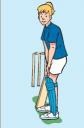
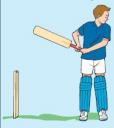
(images from the ECB)
This works well as it is simple to teach to groups of children who are just starting out. It encourages the head to be still and to play with a straight bat. Something we like as coaches!
The key points about this method are:
- Stand sideways on
- Feet comfortably apart
- Weight on the balls of the feet
- Head still, eyes level, facing the bowler
- Bat is swung straight back over the stumps in line with the shoulders
- Top hand in control with the bottom hand acting as a fulcrum
The perfect batting stance for intermediate and advanced players
Perfect starts to become a bit more difficult when you get to more experienced players.
Once a player is capable of playing a range of shots with good shape and a still head they can be free to experiment a little more with their stance and backswing.
By 'shape' I mean the batsman has stable base with the feet playing forward or back, a strong core, a still head and a smooth flow of the arms through their shots.
You find players who have not had much coaching tend to be further away from the perfect model. The more experienced a player gets the more they develop their own methods. This is built on base of sound technique and experience.
Open stance and trigger movements
Chanderpaul's front on stance (see the picture at the top) is an extreme example of an adapted technique and open stance. Many top batsmen open their chest out like this (though rarely that far). Most also correct this by moving sideways on before the bowler delivers the ball.
This is known as a trigger movement. It's not a good idea to coach trigger movements, especially with kids, as you risk preventing the head being still at the point of delivery.
More experienced players can find such movements useful. They can get you moving on the balls of your feet and focus your attention. Rob Key used a trigger to correct an error where he moved onto the front foot too early.
As a coach I would be looking at the players head at the point of delivery. As long as it is still a player can use any trigger that makes them feel more comfortable.
Backswing and backlift
In modern coaching terms the backlift has been replaced by the backswing although it is essentially the same thing.
Again, advanced players can experiment with what works for them. Some players like to keep the bat raised early like Graham Gooch, some prefer a lower backswing to give more control, especially on the leg side.
What remains essential is the ability to play a range of strokes from the backswing that is selected. If in doubt, go back to the 'perfect' method.
More on all these methods here.
What is your method and if you coach, how do you coach the stance and backswing?
- Login to post comments

Comments
I found using a backswing instead of a more static backlift hugely useful. The backswing had the effect of "unweighting" the bat more which I found allowed me to control the line of the stroke better - probably because of some error in my backlift!
(Can't remember offhand where I read about unweighting - probably on here somewhere )
)
I've also started using the forward press to trigger - as my feet can be very lazy.
I agree Ed it's a better description as it makes it seem more like a smooth golf swing up then down rather than a stitled double movement.
I talked to a golfer who made that connection between the swings before. He found a lot of golfers try to "hit the ball", rather than swing through it. You definitely get a smoother action, (and more power), with this in mind. Jerky movements make timing much more difficult.
I like that idea of swinging through the ball to make a smooth downswing.
Edladd unweighting was a word coined by Greg Chappell on his forum. The forward press is going to limit your batting options.
dissident, I'm not much of a forward press fan either. Why does it limit options?
You tell me David, you are the coach here
I was hoping for your opinion? I have never coached or used the forward press so I'm not really qualified to say. Duncan Fletcher likes it and he is a far better coach than I am. What so you think though?
I wonder if stance needs to be reconsidered once a player knows his strengths and weaknesses. So Chanderpaul has a stance that works for him as he nudges and nurdles - he rarely comes that far forward even when driving.
Someone who played a lot of hooks and pulls, or who played almost exclusively off the front foot like Pietersen, wouldn't benefit from that stance. I suppose from a coaching point of view a starting point is required for youngsters from which they can adapt as it suits them, and the ECB stance does that.
Ed, I agree. When group coaching you have to have some kind of template to work from. A good coach is adaptable to player needs though. The copy book is not always right.
should your weight be on the front foot
Hi abc. The answer, as always, is: "it depends". Most people say your weight should be evenly distributed to be able to play forward or back. Do you have a specific circumstance in mind?
as people say to lean on your front foot when batting so you can hit the ball harder is this true
It sort of depends what shot you arte playing! If we are talking about front froot driving then bending your knee and kneeling into the shot is a good idea. Does that help?
yh thanx
[...] set up I obviously mean the grip, stance and backswing all of which are so important to produce the correct outcome of any shot. I have previously been [...]
[...] So for our sweep shot example you would start the shot from your normal stance, moving through the backswing and step, into position and shot [...]
The forward press is a good option as it shifts the weight onto your front foot, getting you to arrive at the ball earlier. It is only really practical against very quick bowling, but if the press is adopted it must be followed all the time, i.e. against a spinner as well. It is also very easy to transfer your weight straight onto your back foot simply by rocking - as anyone who has used this technique can tell you.
for me, the forward press is something that might be useful against a ball that is consistently full of length. Perhaps more suitable vs spin. Although, it may be tricky to do one thing vs one type of bowler and something else vs another. I like the idea of a rhythmical backswing in time with the bowlers are coming over, like Ponting, although I like Bell's method also.
What is Robert Key's trigger movement? I go on the front foot too early. Maybe his trigger movement help me as well.
My knee dosent bend when i play a seamer so hw to improve it
There are drills to improve that problem in PitchVision Academy.
I have been told by my batting coach that I should use Kevin Pietersen's trigger move. I have wtched him on TV and the Internet but still don't know where position myself. Can you tell me?
My first question is this: why would you want to?
david I would do it to improve my game my coach gives me adobe like use that trigger move but won't tell me how because he has other people to help and a job.
OK but how would it improve your game?
It would improve my game by maximising the chances of the ball being on a line that I can hit through my strongest area leg sid like kp
I would have to see you to be sure, but I would be highly doubtful that hitting across straight balls is something you can get away with for any length of time, unless perhaps you have exceptional talent.
sorry sbout the delay in reply if you would tell me Kevin pietersen's trigger move i could try it if it dosnt work I will stop but it may work very well nobody knows unless I try it.
I see what you are saying but that is flawed logic. To develop a trigger move takes a lot of hard work. you can't just try it on to see if it suits you like a jumper. Also does the end result really justify all the effort? Maybe it does but I would be more keen to look at your grip, your backlift, your head position and balance first. Can you honestly say they are all perfect every time?
I can honestly say that they are perfect every time
They why try to mess it up with a trigger move? You should be scoring buckets of runs.
I have a "o" grip or what's now called choking grip. I've used it successfully over the years, playing shots throughout the ground, but our new coach asked me to switch it to a more traditional one. I tried to resist, but he said that it'll help me perform better at a higher level. I also hinge the bat with my bottom hand but he still insists that the traditional is better. I really don't know what to do. Can you please help.
The O grip results in inside edge which can get you bowled.
My bat comes down straight as i hinge and use my bottom hand correctly.
i used to tap my bat between my feet and a lot near to the backfoot does it limits my range of shots...
i am a cricketer.when i do batting,i bent my knees largely to see the fastest ball easily.but a batting coach told me to bent my knees slightly.when I bent my knees slightly i can not watch the ball clearly.what will i do?please tell me soon
if u hold the bat using bottom hand u can't move the bat easily to off side.but if u hold it using more power on top hand,using bottom hand as a helping hand,u can move the bat wherever u like
Help please , my son is being coached by someone other than his usual coach for a 10 week session (selected through school as one of only six) and his stance has always been as ecb guidelines feet parallel shoulder width apart. His new coach is telling him to open up and turn his front foot out to clear his leg for shots. This has pushed his backswing out to the side and he is uncomfortable and getting bowled a lot. His timing has gone as well.The coach says persevere and it will come back. From reading the info from various forums and the ecb guidelines this seems wrong .Surely if you have good technique why would you change it?
I wasn't coached as a youngster, so had to find my own solutions to problems that arose when batting: this has perhaps aroused a somewhat perverse antipathy to coaching as I have grown older. With a side-on stance I found that anything down legside (I am right-handed) was out of my reach. My cricketing heroes at the time were the Somerset team of the 1970s and 80s, who included one Philip Slocombe. The few times I got to watch him bat convinced me to adopt his very open Stance: added to the difficulties I was having batting, I am shortsighted and wear glasses all the time.
I didn't play much between 1984 and 1993, but when I resumed, I tried to be more thoughtful about how I batted, and about my stance.It was crucial for helping me move my feet to the ball, by stepping back and across, and finally I was able to hit some nice shots to leg. An attempt to make the sstance less extreme (being at 45° to the wicket rather than 90°, and batting on middle-and-leg) did not work, and now I have an even more extreme stance, on leg stump. There is an added extra that some less-experienced bowlers have a tendency to deliver at the batsman, and so become fodder for my leg glance, drive or pull. It wœuld be illuminating to make a historical study of this variation of the batting stance, as there appear to have been clusters of its usage. Around the same time as Slocombe was using it, so were Willey, Randall, and I think Jeff Dujon.
Whenever I place my bat on the ground, my eyes aren't level. What should I do?
I think that tapping your bat is a subconscious habit that helps you focus, but by the time the bowler is a few paces from his delivery stride, you should have at least started your backswing.
I also suggest that in the backswing, you use the bat movement that AB de Villiers uses, he only has a half backlift but then he swings it up and back down through his stroke. He says the rhythm helps the timing of his shot. He is not the only exponent of this, Steve Smith also uses it.
Lastly for a more experienced batsman, you could experiment with the back and across trigger movement. These two also use this trigger movement, Steve Smith's version is probably too expansive for most, but AB's method is easier. One problem with this is that your head tends to move, but if you time this movement right before the bowler's delivery stride it can work effectively, just keeps your eyes fixed on the ball.
I suggested these because I have tried many things and being short, I struggled with the constant short deliveries from the fast bowlers and this technique adapted from studying De Villiers and Smith, actually worked for me as I faced better quality bowling.
One thing I do differently is to step forward after the diagonal step back and across in front of my stumps (where I stepped depended on where I intended to hit). I stepped forward after reading Michael Hussey say it is easier to backwards after being on the front foot than vice versa. This actually helps with driving the ball straight down the ground or through the cover region. When I first tried this 2 years ago I managed 144 in a T20 match, so it did help me at least. . Once I did manage to sweep/paddle some medium pace for 6 so that was a fluke out of desperation.
 ..... dont take 2 years though please....
Although it has improved my overall batting performance, one area I have constantly struggled with right from day one is hitting anything targeted at my front (left) ankle. I can block it, usually before losing my balance and sometimes falling over
If somebody can help me with this, it would be great,
Just reading it, I realised that it doesn't much sense.
By stepping back and across, then forward, I mean, moving my back foot back in front of the stumps then rocking onto my front foot forwards to shift my momentum through ball as I hit it. If the ball happens to be short I rock back onto my back foot and play it.
It probably sounds weird but it works, just imagine a more moderate Steve Smith technique with emphasis on the front foot.
Hope that's easier to understand ;D
i am played good