

Field Settings: Leg Spin, Tail Ender and Set Batsman
This article is part of "The complete guide to cricket field settings" series.
Imagine a game situation where you have a tail-end batsman at one end, and a well-set batter at the other end. It makes senses to spend more time bowling at the weaker player. You are more likely to get a wicket.
The trouble is that the set batsman will do everything he can to stay on strike by hitting boundaries in the over then stealing a single on the last ball.
You don't want to defend this tactic alone as you still want to try to bowl both players out. But you also want to stop the boundary shots.
So you set an in-out field.
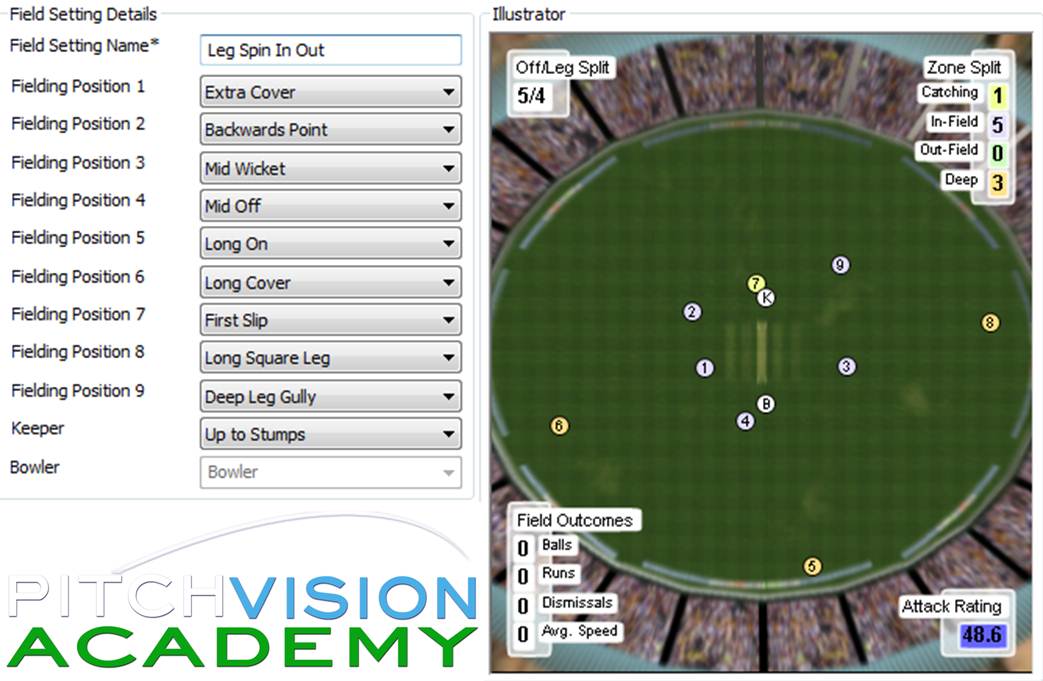
Bowling to this field
You continue to bowl with the aim of taking wickets. That means bowling a line so that when the ball turns it is hitting the top of off stump. Make the batsman play through the off side.
Your length will be full enough to draw the batsman forward,looking to drive; ideally popping a catch to slip or the keeper.
For tips on bowling with accuracy and tactical nous in this situation (and many others) click here to get Leg Spin videos on PitchVision Academy
If he looks to sweep off the stumps you have a great chance for LBW and even if he makes contact you have catchers in position.
With the field, set the ring fielders back deeper than normal so the batsman has the option of taking the single, but keep them close enough that they can catch the mis-hit boundary attempt.
Bowling variations
As a leggie you may have a number of variations with which to play. Your stock ball is still the key but you are also still looking to the batsman's weaknesses. Based on that you may find the following effective as occasional variations:
Avoid bowling
Any ball that allows the batsman to score a boundary in the first few balls, or pick up a sneaky single in the last ball. Length is key, but any ball that allows the batsman to go leg side is likely to be punished.
Field variations
The obvious note here is to bring the field up for the last 2 balls of the over: All fielders on the boundary can move in to save one.
You can bring in an extra catcher from mid on to silly mid on to add pressure to the set batsman. Midwicket can also go to short leg if deep square leg is out. Decide which position is most likely to get the catch as it is rare that you can have 3 close catchers in this situation.
Point can also be moved out to the boundary to give the batsman one and save a four.
Batting against this field
As the set batsman, your tactic is to protect the tail-ender but also to score runs. You don't want to do this at all costs unless you know the player at the other end is a total rabbit.
So, look to score with orthodox shots: off and straight drives. If the bowler drops short look to cut, pull and back foot drive into gaps. Don't be afraid to let the batsman at the other end face a few balls. Many batsmen get in a tangle trying to keep strike.
Think about cutting out the extra cover and square drives as the bowler is looking for you to edge the ball. Certainly avoid higher risk innovative shots unless you need to score quickly.
- Login to post comments

Comments
Hello mr. David.
When bowling to right handers I have a very unique field setting, it isn't entirely similar to an off spinners because I have much more variation than off spinners and get more turn, different angles etc. Could you please tell me if there are any flaws in this field setting? (left arm unorthodox bowling to a right handed batsman around the wickets, occasional googly,off spinner, top spinner and various backspinning deliveries)
1. bowler
2. keeper
3. first slip
4. cover
5. short leg
6. deep mid on
7. mid off
8. deep square leg
9. mid wicket on the boundary (for well timed slog sweeps)
10. point
11. deep extra cover
Well Jacques Voigt,
I don't know what David thinks but I think that is a field without any logic.
Every good ball you bowl would be pushed into the leg-side in front of square for one, possibly two. Anything short and straight would be dispatched behind square for 4, or nurdled round the corner for two.
The well-set batter could easily manoeuvre twos.
You would be going at five an over (at least!) without the batter taking any risk at all.
The aim should be that if you are bowling well, the batter must take risks to score at more than 2-3 per over.
Bring mid-wicket in on the one, put slip behind square on the leg-side saving one and bring in the utterly unnecessary deep extra cover. That would make your field only mildly flawed instead of idiotic. You can lose the short-leg too - if you need three guys out on the fence I think he might be grateful tbh!
Vic K
I don't agree with most of the things you said, for example I cannot be 'pushed' into the leg side for one, two, three or a boundary because of where I pitch the ball and any shot towards the leg side is very risky. Trying to do that is trying to play a ball that drifts from off stump to 2.5 feet outside off stump and landing 2 meters from the popping crease, turning in hitting middle. Its impossible to play back and the only safe shot would be the cover drive which isn't so safe after all because it is against the turn and straight towards cover or deep extra cover. If there is a lot of rough or if they are trying to glance towards the leg side (which is suicidal) the short leg would come in useful and the slip is there for a very good reason, the well placed googly / top spinner / slider / off spinner regularly gets a nick straight towards slip. If a batsman is hitting towards point even though I pitch very full I can just set him up by bowling a backspinning leg break that lands fuller than expected. I thrive on batsman double stepping, they get subdued by drift, batsman who play the slog sweep well against me are my only threat (deep mid wicket takes care of that) and if they are good with the on drive I can limit that to a single (deep mid on) With this field my average is 13 and my economy rate 2.5 so I don't think its that idiotic after all.
It just goes to show that if a field works for a bowler then he should stick with it no matter how crazy it seems to someone else. But that begs the Jaques, why did you ask if it was a good field when you already knew the answer?
Hello David
I just wanted to know if someone else maybe had any suggestions or if there are any flaws in my plan. (I do concede a lot of runs against tail enders who don't have a clue facing spin but are always doing crazy things that eventually work out for them) But I can imagine that it is difficult for someone to set a field for me if they have never seen me bowling. It isn't everyday that you find a chinaman bowling around the wickets and my style really is very unique. I have double jointed wrists (like Murali) and a very flexible shoulder. Setting the field can really be a nuisance to me and I want to get that behind my back as I don't want to spend all that time setting up a field when I could be focusing on more important things, after all as a bowler the best way to get the batsman out is destroying his off stump and ripping the bails off, not just creating a possibility for a catch.
Seems like you answered your own question again then! Maybe you would consider a midwicket and leg side 45 against a tail-ender then?
Thanks David that could work, I've noticed that they don't pick any of my variations and they usually double step to the point where they are standing in the middle of the pitch trying to hit me out of the park, true sloggers! I have tried leg side stumpings and even off side stumpings but then they just madly swing their bat and somehow connect the ball and get a lucky edge past the keeper for a single. They are always getting nicks all over the place its just ridiculous! When they stay in their crease they are in all sorts of trouble. Its a good idea to bring mid wicket in because if they slog sweep it could be a catch or 4 runs, if its 4 they will be tempted to go for that shot again and I can slip in the backspinning leg break which lands fuller than expected. I have considered placing lots of fielders around the bat to put pressure on the batsmen and make them play risky shots to my different types of leg breaks and I know that Warne had about 5 fielders around the bat but do you think it could work and which types of batsmen succumb to this tactic more easily than others?
i am a right arm leg spinner. my field is as follows please tell me if there are any flaws:-
1 slip
2 gully
3 point
4 sweeper
5 long off
6 long on
7 deep mid-wicket
8 deep square leg
9 short fine leg
It's a reasonably good field, but why long on and long off? Batsmen thrive on those fielders! They can just push any ball past you and take a single, so they basically keep the scoreboard ticking at 6 runs an over. This field is more effective in my view:
RHB: 1 Slip
2 Point
3 Cover
4 Short extra cover
5 Mid-off
6 Mid-on
7 Short mid wicket / deep mid-wicket
8 Deep square leg-in front of square
9 Square leg- a little behind
LHB: 1 Slip
2 Point
3 Cover
4 Short extra cover
5 Mid-off
6 Mid-on
7 Short mid-wicket / deep mid-wicket
8 Deep backward square
9 Backward square
The field set is good but corrections can be made for the betterment in your spells.
1.second slip
2.backward point
3.silly widish gully [ for late cuts]
4.cow corner
5.long on
6.mid off
7.mid wicket half way down
8.square leg
9.widish leg slip
10.keeper upto the stump
i am right arm leg spinner .what should i do when the lefty batsman is hitting me
hi I'm a right hand leg spinner, I wanted to know if you know any effective bowling plans and how to set up batsman well. I can bowl a leg spinner, googly, top spinner, quicker ball(I bowl it rarely).
For a leg-spinner bowling to a RHB, I've found this field extremely good.
1. Bowler
2. Keeper
3. Gully (45°)
4. Point
5. Cover
6. Mid-Off (Back 15m)
7. Mid-On (Back 15m)
8. Short Mid-Off
9. Mid wicket
10. Deep Square Leg
11. Leg Gully (45°)