

How to Rotate the Strike
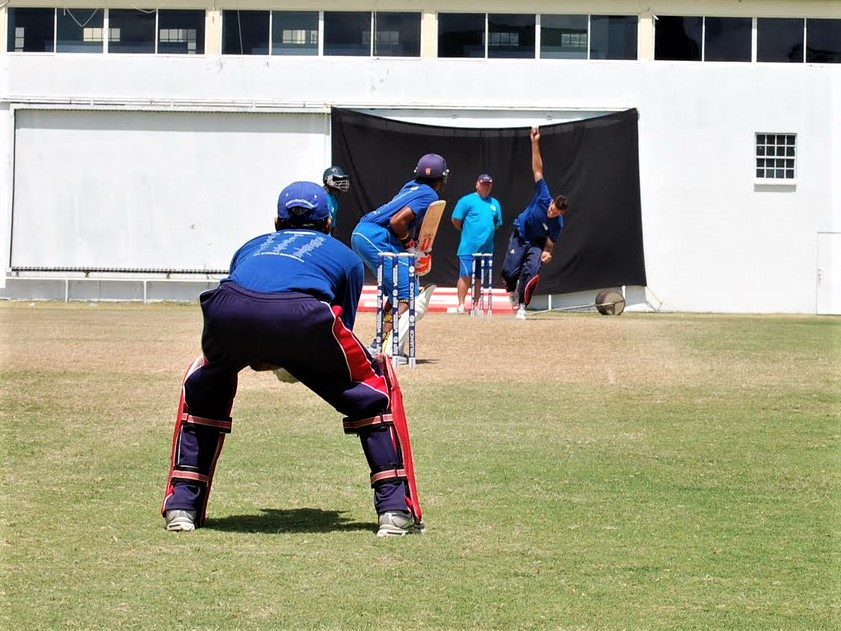 How would you like to add an extra run per over to your team's score?
Running between the wickets is one of the few genuine moments of teamwork in cricket. You have to work closely with your batting partner and have an understanding between each other. While this can happen naturally (you are probably thinking now of a batting partner that you run well with) it often fails. This leads to missed run chances or even run outs.
Both can be avoided.
Escaping the net mentality
Think back to your last team practice session. How many chances did it give you for really practicing running with a partner? You were stuck in a net, playing your shots and not having to work with a partner.
Because of this net practice, rotating the strike is a skill that is not often developed. Naturally, chances to score extra runs are missed and teams settle for far fewer runs. It's especially true of sides with a player or two who slows the rate through lack of confidence in playing their shots. No amount of netting is going to help these problems.
So let's assume you are staying out of the nets and working on strike rotation. What do you do?
1. Think about the simple tricks first
Let's assume you know the basics of running between the wickets: Calling, turning and the like. Sit down as a team before you start your practice session and talk about the more advanced common sense tricks you can use to steal runs and frustrate bowlers who are looking to keep the score down.
The idea of these tips is to develop the fast and simple tactical things you can start on right away. There is no lag time between practice and matches and they can start making an instant different to your score.
- If it hits the pads, it's usually a run. Most of the time a ball deflecting off the pads goes into an area with no fielders. If the non-striker is aware they can call the striker through for an easy run before keeper, fielder or bowler can get to the ball.
- Always look for another run. The trick with this is just to change mentality. If you are always looking for the extra run you will get it when the chance comes. You never know when a simple return will turn into an overthrow. Stay alert for another run until the ball is dead every time.
- Play tip and run. A classic mistake a club level is to assume tip and run is a specific tactic for when a batting team is getting tied down. What's stopping you from using the tactic throughout an innings? If you have a good defence all you need to do is think, "quick single" after you have played the shot. Defend the good balls and set off.
- Pick out the poor fielders. Every side has better and worse fielders. If you are in the middle you should know who the ones are who stand a little too deep to save a single, collapse in key moments or are always surprised when the ball comes to them. It's these fielders you can exploit and make it home easily.
- Decide when to run. Although you can play the hit the gap game through an entire innings, it most efective early on. If the going is tough early on, your running can keep you in the game. Towards the death of an innings you might be looking to hit more boundaries and so stealing becomes less effective.
Once you have your mentality sorted you can move the training session on to a simple batting drill in the nets.
Put different coloured cones at various fielding positions such as point, square leg, mid on, mid off, midwicket and cover. Hit the ball to each cone in turn. Do this adjusting the angle of the bat and your body position to find a way to get the ball in position. More about this drill here.
The drill is very flexible and can be done with bowling machine, sidearm or bowlers. The more you do it the better you get at learning how to play the ball away from fielders and through the gaps. You can also enhance it greatly with smart-nets as you can see what balls are most likely to give you the best outcomes, and review the videos.
Judgement skill is one of the best ways to improve running and run rate. Most club players sensibly err on the side of safety, not taking runs that might be a little tight. However, with a little practice you can get your own team's judgement up to a much higher standard.
This game (you will need a few players to make this work) shows you how to do this:
- Set up the fielders and coach in the same positions as the 360 degree fielding drill.
- Add in two batsmen to run (ideally the pairs will be put together in a way that they are likely to bat together in games, for example the regular openers should be a pair).
- The batsman hit a coach feed out the fielders with the am of hitting a gap for a single. Score as many as possible.
- Initially the pairs should try to run for everything. This will lead to run outs but will also show the batsmen that there are perhaps more runs available than they think.
- Once every pair has had a go, do the same drill but allow the players to judge runs. You can make it competitive by keeping score; the pair with the most runs is the winner.
You can also play middle practice. I recommend Battle Zone cricket for one of the best games to improve strike rotation.
By the way, you can use PV/VIDEO or PV/MATCH in these scenarios too. Recording these sessions gives everyone such focus and intensity as they know their actions are all on camera and counting to the "net average".
These elements will put your team far ahead of most others at the level you play.
Certainly more than another hit in the nets would. It just takes a little bit of creative thinking but it's a fun way to spend a training session as well as providing a valuable lesson.
- Login to post comments

Comments
I think you should make an article on agrresive batting for No.6's &7's
Cheers
when i angle the bat i end up slicing it to a feilder or it hits the face of the bat and goes to the keeper how can i help this from happing
a bats man hit a ball and he became caught out before that they cross the centre what will be the place of new batsman
a bats man hit a ball and he became caught out before that they cross the centre what will be the place of new batsman
anoop it will depend whether the batsman crossed with the nonstriker, if they both crossed the nonstriker becomes striker and new batsman is non striker.
The center of the pitch is not the indicator whether the new batsman will be striker or non striker